Furnace guide · October 8, 2026 · 6 min read
How Often Should You Change Your Furnace Filter?
It’s the cheapest piece of furnace maintenance there is, and the one most often forgotten. Here’s a straightforward schedule by filter type, the signs a filter is overdue, and what Lincoln homeowners should keep in mind.
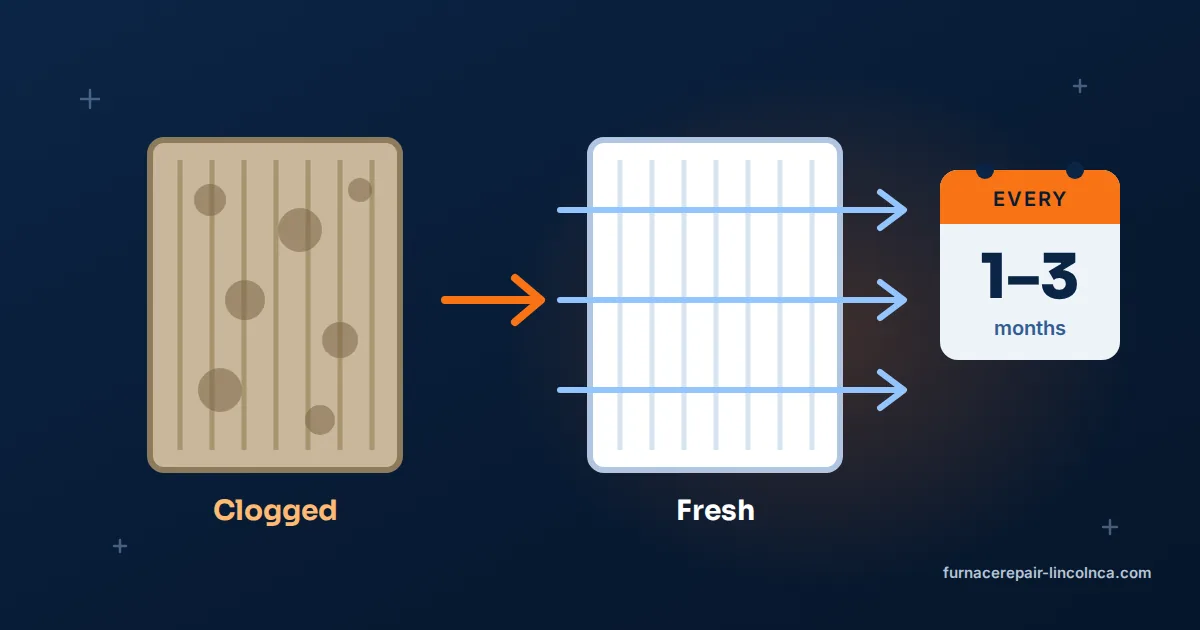
How often should a furnace filter be changed?
For most homes, check the filter every month and replace a standard 1-inch filter every 1 to 3 months. Thicker 4- to 5-inch media filters usually last 6 to 12 months. Homes with pets, allergies, heavy dust or nearby smoke need more frequent changes. When in doubt, follow the filter maker’s guidance and replace it whenever it looks dirty.
The filter’s job is to protect the furnace as much as your lungs. It keeps dust off the blower wheel, the heat exchanger and, if you have central air, the indoor cooling coil. A clean filter lets air move freely, so the furnace heats faster, runs cooler and wears out its parts more slowly.
How long does each type of filter last?
| Filter type | Typical replacement | Notes |
|---|---|---|
| 1-inch fiberglass | About every 30 days | Inexpensive, catches only larger dust. |
| 1-inch pleated | Every 1–3 months | The most common choice for homes. |
| 2-inch pleated | Every 3–6 months | More surface area, so it loads more slowly. |
| 4–5 inch media | Every 6–12 months | Fits a dedicated cabinet beside the furnace. |
| Washable / reusable | Clean monthly | Must be completely dry before reinstalling. |
These ranges are starting points, not rules. The filter’s actual condition matters more than the calendar, which is why a quick monthly look beats any fixed schedule.
When should you change it more often?
- Pets: shedding dogs and cats can clog a 1-inch filter in a few weeks.
- Smoke: during wildfire smoke in Northern California, filters load up fast. Check them every week or two while the air is smoky.
- Remodeling: drywall sanding and construction dust can ruin a filter in days.
- Year-round use: in Lincoln, the same filter usually serves the air conditioning all summer, so it may be loaded before heating season even starts.
- Allergies or asthma: a cleaner filter helps, so err toward the short end of the range.
What are the signs a filter is overdue?
- It looks gray or matted. Hold it up to a light; if you can barely see through it, replace it.
- Weak airflow at the vents. The furnace is running, but less air comes out than you’re used to.
- Short cycling. The furnace turns on and off frequently as it overheats and trips its limit switch.
- Rooms heat slowly or unevenly. Restricted airflow shows up first in the rooms farthest from the furnace.
- More dust around the house. A saturated filter lets more dust pass through.
- Higher energy bills. With similar weather, a furnace fighting a dirty filter runs longer.
A badly clogged filter can even leave you with lukewarm air, one of the causes covered in our article on why a furnace blows cold air. Over time, the strain also wears out the blower; the blower motor repair page explains how.
What MERV rating should you choose?
MERV is a 1-to-16 scale for how well a filter captures particles; higher numbers catch smaller particles. For most homes, a pleated filter in the MERV 8 to 11 range balances filtration and airflow well. MERV 13 filters capture fine particles such as smoke much better, and are often suggested during wildfire season, but they can restrict airflow on systems not designed for them.
If you switch to a higher-MERV filter, watch for weaker airflow, a noisier blower or short cycling over the next few days. Those signs mean the filter is too restrictive for your system. A technician can check static pressure during a furnace tune-up and tell you what your system handles comfortably.
How do you change a furnace filter?
- Turn the thermostat off so the blower doesn’t pull dust in while the filter is out.
- Find the filter. It may be in a slot beside the furnace, in a cabinet next to it, or behind a large return grille in a hallway ceiling or wall.
- Note the size printed on the frame, such as 16x25x1, and buy the same size.
- Check the arrow. The airflow arrow on the new filter points toward the furnace, away from the return grille.
- Slide it in snugly with no gaps around the edges, close any cover, and turn the system back on.
- Write the date on the frame so you know when it went in.
Never run the furnace without a filter, even for a day. Dust goes straight to the blower and heat exchanger, and a filter installed backwards or the wrong size lets dirty air bypass it.
A clean filter prevents many problems, but not all of them. If the furnace still short cycles, smells unusual or won’t heat after a filter change, it’s time for a professional look. Our overview of Placer County furnace repair explains the most common causes and how the referral works.
Furnace filter FAQs
What happens if I don’t change my furnace filter?
Airflow drops, the furnace runs hotter and longer, and it may start short cycling. Over months, that extra strain shortens the life of the blower motor, ignitor and heat exchanger, and raises energy use.
Where is the furnace filter in a newer Lincoln home?
In many newer homes, especially those with attic furnaces, the filter sits behind a large return grille in a hallway ceiling or wall rather than at the furnace. Some homes have more than one return with a filter in each.
Is a more expensive filter always better?
Not always. A very dense filter can restrict airflow on some systems. A mid-range pleated filter changed on time usually does more good than a premium filter left in too long.
Do I need to change the filter if I don’t use the heat much?
If the same blower runs your air conditioning, the filter keeps working all summer. Check it before the first cold night, since it may already be loaded from cooling season.
Need more than a filter?
Talk to a local heating pro
When a filter change isn’t enough, an independent local provider can check the blower, airflow and safety switches.
(916) 884-9392